
Foundation Connections

Embracing the Chaos: Finding and Giving Support in the Counseling Profession
Published 5/29/2026
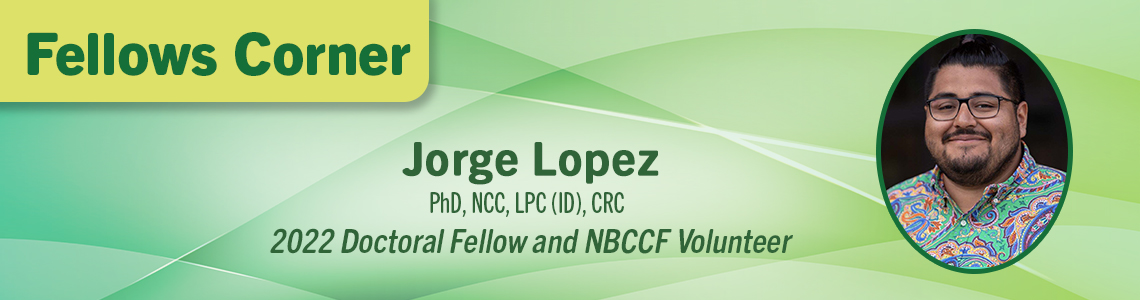
A first-generation student, Jorge Lopez, PhD, NCC, LPC (ID), CRC, saw firsthand that support can change the direction of a person’s life. To him, “the journey can be chaotic, but there’s beauty in the chaos.”
As a child, he dreamed of becoming a cardiologist because of his mother’s heart condition. But life had a different path waiting for him. After realizing the difficult path to becoming a cardiologist, he decided he would have to help in a different way.
“I knew I wanted to help,” Dr. Lopez shared. “I just didn’t know Counseling would be the way I wanted to help.”
Academic struggles then led him to a required support plan that included college counseling. What could have felt discouraging instead became transformative. For the first time, he saw Counseling as another avenue for helping people feel understood, supported, and empowered.
Today, Dr. Lopez has embraced the unpredictability of that journey. He now teaches future Counselors, supports clients, mentors students, and advocates for creating more connected spaces in mental health and education. Through each of these roles, his message is always that no one succeeds alone. Support is essential and should not be overlooked.
“Counseling is very relational, but at times it can also be one that requires isolation because we keep some things private from our clients due to confidentiality and all those different variables.”
His advice to his students? “Make sure you use the profession and community. That’s how I was able to create a support community within my professional space, finding folks who were interested in the same work and the same things even outside of the professional world.”
Over time, the professional relationships he built became something more personal. Colleagues became close friends and, eventually, family. That sense of community has sustained him through the challenges of balancing his professional and personal goals. He recognizes that his accomplishments are connected to the sacrifices, encouragement, and support of others, many of whom may never receive public recognition for their impact.
That mindset has also encouraged him to take opportunities he may have once doubted himself capable of pursuing. He recalls applying for the NBCCF doctoral fellowship after someone encouraged him to simply go for it.
“The experience became one of the most meaningful experiences I’ve ever had, both academically and personally.” The fellowship offered much more than funding. It created lasting relationships, mentorship opportunities, and a network of professionals who continue supporting one another.
“To do this work in community, that’s how sustainable change is made.”
While Dr. Lopez is passionate about his work, he is equally intentional about finding moments of rest and reconnection. For him, rest is found in community and family by spending time with loved ones, watching his young daughter grow up, and preparing to welcome another child into the world.
Even professional spaces like conferences have become opportunities for restoration. Though conferences are often associated with networking and professional development, he says they also provide opportunities to reconnect with colleagues and friends scattered across different states and career paths.
“So, it’s just embracing and living in the moment as much as possible. That’s where I find rest.”
When asked whether it feels easy to pour into others while balancing such demanding work, Dr. Lopez replied, “I don’t think anything can be easy. Especially in the times we live in, where human experience is so diverse and unique based on so many variables.”
Instead, he describes his work as intentional. Whether he is teaching Counseling students, mentoring young professionals, or sitting with clients through difficult moments, he sees meaning in helping others navigate their own growth. Watching students evolve into Counselors and hearing about the impact they make in their communities reinforces why the work matters.
“I always tell my students: we’re not in the business game, we’re not in the numbers game — we’re in the human game,” he said. “We support people. And I think that, for me, is what makes it intentional.”
That philosophy shapes every aspect of his work. Rather than focusing solely on outcomes or achievements, Dr. Lopez centers relationships, empathy, and authenticity. He is especially passionate about mentorship and the ways ordinary people shape lives in extraordinary ways.
One of the most influential mentors in his life was his uncle Hector, who never graduated from high school. Despite lacking formal credentials, Dr. Lopez describes him as one of the smartest, funniest, and most authentic people he has ever known. His relationship with his uncle taught him that mentorship is not reserved for people with titles or degrees.
“We all have wisdom to give.”
He encourages those who doubt their qualifications to support others to reconsider what mentorship truly means. Sometimes guidance comes through lived experience, encouragement, humor, consistency, or simply being present for another person. At the same time, he acknowledges that mentorship requires energy, intention, and emotional bandwidth. Still, he believes meaningful support matters now more than ever in a society where many people feel increasingly disconnected.
That need for connection is especially visible in conversations surrounding men’s mental health, particularly within Latinx communities. Dr. Lopez believes cultural shifts are happening, even if progress remains gradual. As an example, he points to his own father as someone he once never imagined would pursue mental health services. Through advocacy, conversation, and growing awareness, however, those barriers have slowly begun to shift.
The COVID-19 pandemic also changed how many people think about emotional wellbeing, grief, burnout, and support. Dr. Lopez believes these conversations have helped create more openness around mental health, though he emphasizes there is still significant work to be done. Importantly, he sees men’s mental health as both culturally specific and universally human. While different communities experience unique barriers and expectations, many struggles surrounding vulnerability, emotional expression, and support overlap across cultures.
“There’s still much more work to be done,” he said.
That same encouragement extends to young professionals entering the Counseling profession. Dr. Lopez urges students and emerging professionals to pursue presentation opportunities, even if they start small. Whether through poster sessions, roundtables, or conference presentations, he believes that sharing one’s voice matters.
“You all have been claiming space your whole life,” he tells students. “The opportunity to present is just another room you’re walking into.”
For Dr. Lopez, presenting is about more than professional advancement. It is an opportunity to connect with others doing meaningful work and to remind people that their perspectives, experiences, and voices deserve to be heard. That belief also shapes his approach in the classroom, where some of his favorite courses to teach are skills-based Counseling classes involving role-playing, mock counseling sessions, and self-reflection.
He describes Counselor Education as a process that requires students to “sit in front of themselves before they’re ready to sit in front of a client.” Those moments of reflection, discomfort, and growth are central to his teaching philosophy. He believes meaningful learning happens when people are both safe and challenged.
One statement he shares with students each quarter reflects that philosophy clearly: “I care about your safety, but I don’t necessarily care about your discomfort.”
For him, discomfort is often where growth begins and shouldn’t be avoided. He encourages students to remain curious, especially when engaging with perspectives or experiences different from their own.
“We can be safe and uncomfortable at the same time,” he explained.
“I always believe in calling students in versus calling them out.” By doing this, he is creating classrooms rooted in dialogue, empathy, and accountability. Even now, as both educator and clinician, Dr. Lopez sees himself as someone still learning alongside his students. “My pedagogy is relational cultural theory, which emphasizes mutual respect, understanding, empathy, and authenticity, and shared opportunity for growth.”
He intentionally works to reduce power differentials in the classroom, especially within remote learning environments where creating genuine connection can be more difficult. In distance-learning programs, he says students often miss the small interactions that naturally happen between classes. Because of that, he believes connection in virtual spaces requires even greater intentionality.
“My intention,” he said, “is that I’m in the business of helping and supporting people.”
When asked about the legacy he hopes to leave behind, Dr. Lopez reflects on something he heard once that deeply resonates with him: the idea that meaningful work is often like planting a tree whose shade you may never personally experience. Change is slow. Growth takes time. The impact may not fully appear until future generations benefit from it.
“That’s what I want my legacy to be,” he said. “Not that I left the world a better place—I don’t think that’s it. It’s more that people felt supported by me.”
Dr. Jorge Lopez is an Assistant Professor in Counseling at Palo Alto University. He received his BA from UC Riverside, his MS from Georgia State University, and his PhD from Idaho State University. He is a 2022 Doctoral Fellow and NBCCF volunteer.
To learn more about the NBCCF Fellowship program or explore ways to get involved with the NBCC Foundation, please contact the Foundation at foundation@nbcc.org .
Share Article


