
Foundation Connections

A Lifetime of Volunteering and Counselor Education
Published 4/30/2026
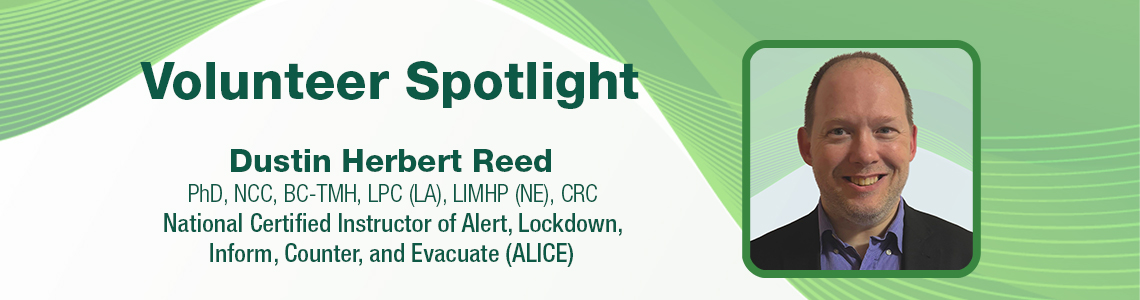
What does it mean to be a Counselor Educator? For Dustin Herbert Reed, PhD, NCC, BC-TMH, LPC (LA), LIMHP (NE), CRC, National Certified Instructor of Alert, Lockdown, Inform, Counter, and Evacuate (ALICE), it means sharing knowledge with Counselors and Counselors-in-training to promote growth within the profession.
“To me, being a Counselor Educator is helping to train the future of the profession to counsel people with diverse needs, backgrounds, conditions, and concerns. Through this process, that involves many areas—from ethical behaviors, skills and theories of Counseling, understanding diagnosis, treatment, and how to be competent in working within the field. Also, part of being a Counselor Educator is helping contribute to the field through service, supervision, publication, research, and presentation of information to the Counseling field at large.”
With a master’s degree in rehabilitation counseling from Louisiana State University and a doctoral degree in counselor education and supervision from the University of Holy Cross, Dr. Reed has been in the profession since becoming a Certified Rehabilitation Counselor in 2013. His interest, however, began long before then.
“I started at a young age listening to others’ stories, analyzing what they were saying, and giving my interpretation of what I thought I heard. After I was done with my undergraduate program, I was thinking of different graduate programs to look into, as well as finding help through the Louisiana Rehabilitation Services for jobs that fit my differing abilities. The director of one of the job placement services told me about the Louisiana State University’s Counseling program at the New Orleans Health Sciences Center. Once I learned more about that area, I knew that was what I wanted to focus on. Being a person with a disability, I was instantly drawn to helping people with disabilities help themselves.”
But a master’s degree wasn’t enough. At 14, he watched his mother obtain her PhD while living with polio and raising seven children. This was the push he needed to commit to becoming a doctor of some sort before even graduating high school. Once he learned about Counseling, his focus turned to Counselor Education and Supervision, and he never looked back. “My aim is to be a model for ethical, responsive, open-minded understanding of others—how to help those people help themselves.”
Over his tenure, Dr. Reed has taught courses ranging from Psychopathology to Career Development and Counseling, but his favorite is Legal and Ethical Issues in Counseling. “One thing I love about the Legal and Ethical Issues in Counseling course is seeing students begin to understand that the ACA 2014 Code of Ethics and any specialty codes are not just words in a document. I love seeing their realization through the course that the codes apply to them as students and guide the scope of what makes Counselors who we are vs. who we are not (i.e., not Therapist, not Psychiatrist, not Psychologist, not Social Worker). Further, generally in this course, students begin to connect how ethical behavior ties into laws and other real-world implications.”
To match the ever-changing landscape, Dr. Reed believes there’s always room to improve the education of emerging Counselors. Along with courses specific to Telemental Health Counseling being required, he envisions incorporating artificial intelligence (AI) into the curriculum. Though, he does think more research is needed on the ethical concerns of AI as it pertains to Counseling. “For example, finding ways to use AI in the training of different skills to help students advance in ways that traditional methods of book learning, video watching, testing, etc., do not address in the learning process.”
When asked what he hopes to contribute to the Counseling profession, Dr. Reed explains, “I hope to continue to help across the profession in leadership roles through servant leadership and dissemination of literature, through publication, teaching, and collaboration with those in the profession, as well as interdisciplinary collaborations where possible.”
Volunteering is another passion of Dr. Reed’s, which he has been involved with since his early teenage years. Outside of Counseling, he has volunteered with the Spina Bifida Organization’s Camp Friendship, Children’s Hospital in New Orleans after Hurricane Katrina, and he began tutoring at age 18. Eventually, his volunteer work expanded and began to coincide with his studies during his master’s program, where he participated in one of the program’s open house family days and assisted in grant renewal efforts for a peer liaison program during a grant writing course.
He didn’t stop there.
“The real joy began in fall of 2014, when I volunteered to be a Doctoral Teaching Assistant at the University of Holy Cross New Orleans. During that time, I co-taught and taught courses and began the mentorship of master’s and undergraduate students.” While looking for his first paid position, Dr. Reed moved on to other volunteer opportunities, such as a full-time internship and an LPC role. He was invited to serve as a Graduate Student Representative with the Louisiana Association for Spiritual, Ethical, and Religious Values in Counseling. Since then, he has served as Member-At-Large and President and will begin a second term as President beginning in July 2026. He is also the current Treasurer of the American Rehabilitation Counseling Association.
Previously, Dr. Reed has supported the profession through academic engagement with NBCC’s The Professional Counselor (TPC) by serving as an Editorial Review Board Member and then as an Associate Editor from 2016–2022. He has taken that commitment a step further and used his expertise to review NBCCF Scholarship and Fellowship applications over multiple years, contributing to the advancement of the Counseling workforce.
Mentoring is a large part of Dr. Reed’s volunteer work. Currently, he mentors doctoral students and candidates, Counselor Educators in the profession as part of the ACES 2026 Leadership Academy and New Faculty Interest Network, and an NBCCF Doctoral Fellow. He has also mentored previous NBCCF Master’s Fellows.
Living with multiple disabilities since birth, Dr. Reed has been told things he wanted to do in life are impossible, but he’s always lived by a saying from his mother: “There is no such word as can’t in this house.” He hopes to impart his own version of this not only to his students and those he mentors, but also to any Counselor who feels unsure about their ability to serve their community through mental health services.
“While you may have ideas that you are uncertain about related to the impacts you can have, do not let the doubts stop you from being the change in the world you want to see. As you feel the uncertainty of whether you can or will be able to make a difference in bettering your community through mental health services or other specialty areas in Counseling, remember, you are here because you chose to help people help themselves. Aim to keep the positive self-talk in your mind. Find support with those you love, trust, or value in terms of mentorship or other areas in life. These areas were all important to my success through the ebbs and flows of my personal and professional life.”
Dr. Dustin Herbert Reed is a part-time Assistant Professor with National University’s Clinical Mental Health Counseling Program and an online Adjunct Instructor with The University of West Alabama’s Counseling Programs. He has made numerous national and state presentations, authored five published works, and has three works in the process of publication.
The NBCC Foundation is honored to work with Dr. Reed as a volunteer, sharing his expertise to shape the lives of Counseling students. To explore ways to help strengthen the Counseling profession, please contact the Foundation at foundation@nbcc.org.
Share Article


